
The Great Book of Wealth
The subconscious makes your decisions about money, business and investing. The conscious mind explains them afterwards.
1,000 pages and 60+ exercises on where the patterns come from, how they operate, and what they cost in a year's numbers.
PDF delivered on purchase · $99 with the audiobook · 30 days to return it
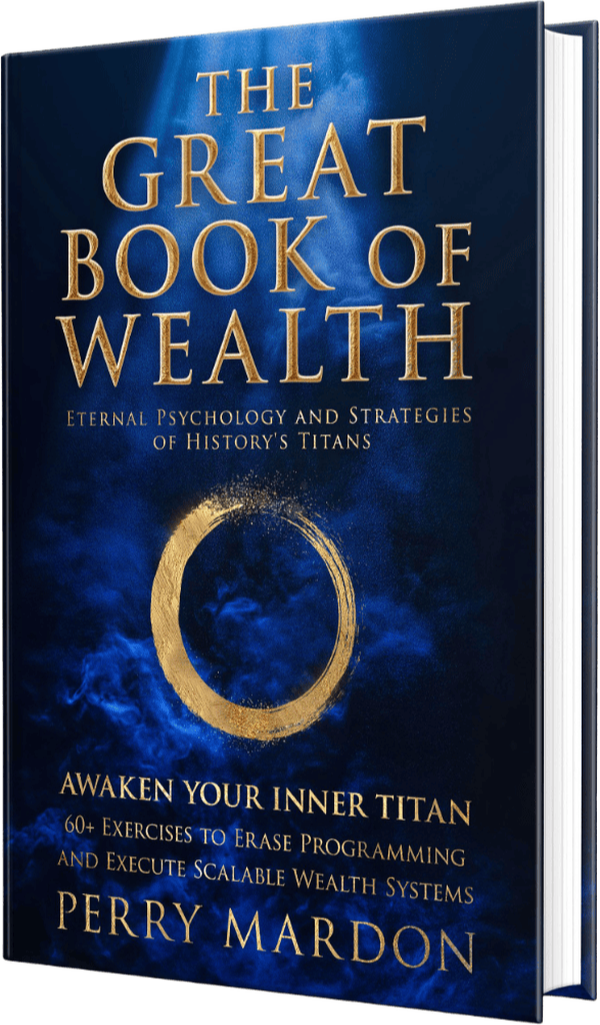
The Great Book of Wealth
The Subconscious Makes The Decision. The Conscious Mind Explains It Afterwards.
Children draw conclusions about money by watching adults. The conclusions harden, drop out of sight, and go on deciding. A price, an invoice, a hire, long before anyone weighs anything.
Nobody has to be told. A parent tenses over a bill and the child reads the reaction.
Olsson and Phelps showed people a video of somebody else being shocked. The watchers were never shocked. Their amygdala response matched the people who were.
A conditioned response argued down is not erased. A second memory forms alongside the first, and in the original setting the first one returns.
Knowing better is not the same as being free of it.
Put into words, the conclusions sound like this:
"I don't deserve that much."
"Money changes people."
"Wanting more is greedy."
Nobody says them. Most would deny them flat. A stated belief can be argued with — these were written by a child who had never paid a bill, and they never get stated. They get acted on.
They show up in the numbers. The price stays. The invoice sits unchased. The second person never gets hired.
Courses train the conscious mind. Sales, investment, business, trading.
That mind explains decisions. It does not make them.
Train that mind and the explanation gets better. The number does not move.
60+ exercises. Each one gets a belief onto paper in the reader's words, then writes over it.
Reader's Edition
$49
1,000 pages, 24 chapters, 60+ diagnostic exercises. PDF, delivered on purchase.
Get The Book →I'll return every cent if either edition doesn't meet expectations. 30 days. No questions.
The Subconscious Sets The Price. It Learned How At Age Seven.
Nothing has overruled it since.
The phrases came first. Money doesn't grow on trees. We can't afford that. Salespeople will say anything to make a buck.
The Screen Taught The Same Rule
The slick car dealer in the sitcom. The pushy door-to-door villain in the cartoon. Manipulative, desperate, untrustworthy.
Then the classroom. Following instructions got the praise, never asking for the money. The loudest, most persuasive kids got called disruptive.
Then the manners. Don't be pushy. Don't talk about money. It's rude to ask for what you want directly.
Not one of those lines mentioned a price. Together they set one.
The knot arrives when the price does. The apologetic tone on the expensive option. The relief when a buyer says let me think about it, because now nobody has to push.
The rule sets the number under what the work is worth, because people don't have money. It skips the follow-up, because salespeople are pests. It hurries the moment the sale is decided, because that is where the discomfort peaks.
It gives the work away before the ask. Asking is the sleazy part. It reads interest as a decision, and the urgency drains out.
Scripts and technique carry the conversation as far as the subconscious allows. Then the number stops in the same place.
The Class Trap
Every class got a different set of subconscious rules about money. Nobody chose theirs.
Some people are raised to control and allocate resources. People, ideas, money, systems. Everyone else is raised to be those resources.
Schools were built to turn out reliable employees. They still do.
Working class conditioning
Money is scarce and must be protected
Rich people are greedy and corrupt
Hard physical work equals value
Worth is measured in labour
Financial success means selling out
The cost: money sits in an account instead of buying anything that earns.
Middle class conditioning
Savings are the path to a secure future
Credentials matter more than assets
Trading time for money is responsible
Debt is dangerous, except on a house
Speculation and risk-taking are irresponsible
The cost: qualifications stack up, nothing that earns ever gets bought.
Professional class conditioning
Expertise is the primary asset
Income and prestige signal success
More hours mean more money
The profession is the identity
Wealth-building is a job for experts
The cost: the income stops the day the work stops.
High-net-worth conditioning
Money is abundant and flows toward opportunity
Assets and systems produce income without daily attention
Other people's resources do the building
Risk is necessary and gets managed
Relationships and access to capital are primary assets
The result: assets that go on producing without the owner in them.
The first three teach the same lesson. Security over opportunity.
The wealth creation system is self-managing assets that produce cash flow and capital growth with minimal hands-on management. Businesses, property portfolios and investment systems that work for the owner rather than the other way round.
The traditional education system has never turned out anyone subconsciously equipped to build one.
I have seen that divide in five thousand wealth creators.
Anyone who reads that as theory can run the test. A month of mornings, four hours a day, off work, on one question: how the business or the investments could run without the person running them.
No email. No calls. No productive work. Thinking.
The reasons against it arrive fast.
Cannot afford to waste that much time. Need to be productive. The clients are waiting. It feels like stealing from the day.
Those reasons are the conditioning talking.
Thinking time is the one asset high-net-worth individuals refuse to give up. They pay others to execute. Thinking is the work, not the break from it.
Thirty-five years of diagnostics went into the exercises in this book. They move the subconscious from being one of the resources to the one allocating them.
Real Life Case Studies
Tony: The Plumber Trapped By His Tribe
Tony was a plumber out of rural Victoria. He chased big dollars and growth.
Every time the profit got near his ceiling, something went wrong. Mistakes in the business that nobody could explain.
He put it to me himself once. That kind of money would mean he'd gone flash. The boys back home scorned anyone with soft hands, and their approval was worth more to him than the growth.
It held the business at the size that kept him one of them.
He worked the exact same exercises you'll get in this book. What shifted was the approval he needed. He stopped checking who was listening.
The Property Developer
She was an accountant and a property developer. She built a portfolio and lost it, and she could not tell me how.
Her subconscious equated power with being unloved by men. The root was childhood attention.
Given a choice between power and love, the subconscious took love. It offloaded the wealth to make her safer to be with.
Call it sabotage. By her own rules it raised the odds of a relationship.
She dug the belief out and tested it against what she wanted. She built again. The woman who had to trade power for love was gone.
My Own Sales Block
I was committed to closing deals and to the income that came with them. Underneath sat a knot in my stomach I couldn't ignore.
My subconscious had absorbed every stereotype going. Simpsons episodes where the salesman says anything for a sale. My parents dismissing the shady salesmen.
My conscious mind wanted the money. My subconscious was certain that going after it meant becoming a rejected, greedy slime.
I reframed it with the exercises in this book. Sales is an act of love. I turned into a sales machine, and I stopped bracing every time I asked for the money.
The Ex-SAS Trader
He spent years as a soldier for hire. His trading account would climb, then most of it would vanish, and he could not see his own hand in it.
The cause was self-punishment. His childhood taught him one rule. The years since taught it again. You pay for what you do wrong.
His subconscious ran on childlike logic and moved before he knew he had chosen.
He worked at forgiving himself and being on his own side.
The sabotage stopped. He no longer owed anyone a debt for his own past.
Sandra's Story: The Wellness Trap
Sandra was a trauma therapist and meditation teacher. She came to me exhausted. Her practice was full. She was earning survival money.
Every time she moved to raise prices, something inside shut it down.
I see the pattern right through the wellness industry. Struggle equals virtue.
Her subconscious told her that money would make her one of them. One of the greedy ones.
She never said it. Her pricing said it for her.
This is the saviour pattern. Her empty bank account was proof she cared. What scared her was being the selfish one, and knowing it.
The therapists I see overgive. They burn out. Then they resent whoever charges well.
More money would mean more healing and more reach.
Sandra worked the exercises and changed it at the root. She made it safe to be paid.
Five people who did the exercises. Most of the people who buy this book never do them.
What you get
1,000 pages, 24 chapters. The full account of where the patterns come from and how they operate.
60+ diagnostic exercises. Done on paper. Each one puts a belief into the reader's own words, then writes over it.
PDF, delivered on purchase. No waiting, no shipping. Read it on anything.
12.5 hours of audio with the Listener's Edition, on a private podcast feed.
30 days to return it. Either edition, every cent back, no questions.
It is a long book. The exercises are the part that does the work.
Reader's Edition
$49
1,000 pages, 24 chapters, 60+ diagnostic exercises. PDF, delivered on purchase.
Get The Book →I'll return every cent if either edition doesn't meet expectations. 30 days. No questions.
Emotion Doesn't Interrupt The Decision. The Subconscious Sends It.
Every wealth creator knows the moment. The strategy is right there, and the decision goes the other way.
Fear. Doubt. Overwhelm. Panic. Greed. Guilt. Shame. None of it arrives at random. Each one is a subconscious belief meeting a wealth goal and firing.
When the emotion lands, the brain changes. Amy Arnsten mapped it at Yale in 2009. Stress chemistry weakens the prefrontal cortex within minutes, and the amygdala takes over the steering.
The subconscious takes the decision. The decision feels justified the whole way.
For investors
Panic selling at market bottoms
Buying at market peaks because everyone else is
Holding a losing position out of pride
For business owners
The confrontation that never happens
The price set low out of unworthiness
The friend hired instead of the expert
Those beliefs are about what is safe, what is possible, and what is deserved. They were set long before anyone had a say in them.
No tactic survives contact with the belief underneath it.
The book works the pattern in four moves.
ONE
Watch the emotion arrive without being carried off by it. Stay there a beat and the decision is still yours to make.
TWO
Read the trigger back to its source. The emotion carries information about the belief underneath, and the exercise follows that trail home.
THREE
Change the belief, not the symptom.
FOUR
Then find out what the price, the hire and the position look like when fear and doubt are not steering them.
The Subconscious Sets The Income Ceiling.
Every wealth creator has a number they are allowed to earn.
The conscious mind sets the goal. A million. Ten million. Whatever the number is this year.
The permission slip sits somewhere else. It carries its own number, and it was written before anyone had a say.
When the two disagree, the subconscious wins.
The ceiling shows itself the same way every time. The same income level, year after year. A new peak, then a client leaves or a bill lands, and the year settles back to its usual figure. Right before the jump, a good operator misses a meeting or quotes too low, and the stomach tightens.
What the conscious mind says
"I want the number. I deserve it. I am running the best strategy I have ever run. I am working harder than ever. I have the skills for this level."
What the permission slip says
"That number is not allowed. More than this is dangerous. Exceeding it will cost you people. Stay in range and stay accepted."
The gap between those two numbers is the income that never arrives. It repeats every year until someone reads the slip.
The permission slip exercise names the number. Then you raise it.
The Subconscious Trades Income For Comfort. It Makes The Trade First.
Its priority is not growth. It is never having to feel what growth costs.
The goals that get set are the ones that cost nothing to feel. A smaller target. A bigger one would test whether the owner is good enough.
The business model that feels safe. Work that stays inside what is already comfortable. A strategy that keeps the owner out of sight, out of the sale, out of the negotiation.
The bigger goal never reaches the list. There is no moment where the owner weighs the money against the discomfort and chooses. Something chose first, and it was not weighing money.
The emotion avoided, and what it costs.
Rejection in a sale
Fewer people say yes, and the sale comes in smaller.
Being visible
Nobody outside the room knows the business exists.
Failing where people can watch
The high-return opportunity nobody takes.
Conflict, or a negotiation
Work that stays underpriced for years.
This is why highly trained, high-IQ entrepreneurs under-earn. Why investors hold back on obvious wins. Why business owners delay building the system. Why brilliant salespeople avoid the close.
Every place the money stops maps to an emotion the subconscious will not feel. It steers around the emotion, and the money sits on the other side.
One of the exercises works the other direction. It starts at the place where the money stopped and names the emotion behind that stop. Naming the emotion is what makes the trade optional.
Every Money Decision Passes One Question First. Is This Who I Am?
That question is not about the money.
The answer was settled early and has not been reviewed since. Not who a person wants to be. Not what they tell people. Who the subconscious decided they are, and then stopped asking.
Four statements, and what each one does to the money.
"I am unlucky."
The opportunity gets passed on, and passing on it looks like prudence.
"I am not as good as the others."
The bigger piece of work goes to somebody else, and the reason given is that it was not the right fit.
"I am an easy-going person."
Assertiveness reads as rudeness. The negotiation gets softened, then dropped.
"I am not a money person."
The numbers stay someone else's job, and so do the decisions attached to them.
The identity that costs the most money is often the one people like most.
I have sat across from the easy-going operator many times. Liked by everybody. The reputation is earned and it is real.
That identity is not the one that prices the work, runs the negotiation, or carries a deal that needs somebody to push. The two cannot both be in the room.
The business stays the size an easy-going person can run. Nobody names the cause out loud, because the cause is the thing everybody likes about the person running it.
An identity holds itself in place.
It screens what gets noticed, so the evidence arriving agrees.
It declines the opportunity that would contradict it, and the reason for declining is ready before the opportunity gets weighed.
Where a result would prove the identity wrong, the last step gets postponed, and the money gets postponed with it.
A goal is a description of the money a person would have. It is also a description of who they would have to be, on an ordinary Tuesday, to hold it. The second half is the half the subconscious reads.
Strategy works on the first half.
The exercises put the statements on the page in the reader's own words, then build the replacement in a form the subconscious can accept.
Written down in the reader's own handwriting, the statement stops being who they are. It becomes a sentence that can be edited. The next money decision meets the edited version.
The Reason Sounds Reasonable. That Is How The Block Survives.
Anything less convincing gets dealt with years earlier.
Every business and every portfolio has a weak area. The part that never comes right, year after year, while everything around it improves.
It gets filed as a skills gap, or a market that was hard from the start.
Underneath the weak area sits a sentence. It is specific, it is old, and the person carrying it has never said it out loud.
The weak area first. Then the sentence under it.
Money never gets tracked and the cashflow stays a guess.
"Looking closely means finding out how far behind I am."
The person who sends the most business is never asked for more of it.
"They already gave me enough."
The holding that is finally working gets sold at the first decent offer.
"Too much profit and I become the arrogant uncle nobody liked."
The decision sits in analysis for months, and the waiting costs more than a mistake would have.
"A wrong call would confirm what I already suspect about myself."
The sentence stays under the surface. What comes up in its place is a reason, and the reason is what gets said out loud.
"I don't have time for this right now."
The time appears for everything else on the list.
"It isn't my strength."
Nobody ever tested it.
"I need to learn more before I start."
The learning has no finish line, which is the point of it.
"I'll get to it later."
Later has been arriving for six years.
Each of those reasons is true. That is what makes them useful to the subconscious.
A reason nobody can argue with is a reason nobody examines.
Nobody around the person challenges it either. It is a reasonable thing to say. It gets accepted, and the weak area gets another year.
The exercises pick up the reason that gets said out loud, then ask what it is standing in front of. The sentence behind it is the one that gets rewritten.
Take the reason given for the area that has never come right. Find out what it is covering.
Reader's Edition
$49
1,000 pages, 24 chapters, 60+ diagnostic exercises. PDF, delivered on purchase.
Get The Book →I'll return every cent if either edition doesn't meet expectations. 30 days. No questions.
There Is A Version Of The Same Decision With Nothing In The Way.
It has a name in every other field. Being in the zone.
Most people have been in it at least once, and hardly ever with money.
The surgeon has it, the musician has it, the bricklayer has it by mid-morning on a long wall. Time goes strange and the work comes out better than they manage the rest of the week.
Wealth creators get it too, in the wrong places. In the kitchen. On a long drive. Halfway through a job that has nothing to do with the money.
Then the money moment arrives and the zone is gone.
It is the same attention a person already gives to the kitchen and the drive. Money is where the interference sits.
The price gets set at what the work is worth, and the body stays quiet.
The deal gets taken while it is still there, at full size.
The hire gets made in a conversation that lasts ten minutes, and the offer goes out the same day.
Afterwards there is no story about why.
That is the same person, with the interference out of the way.
The book is an account of the interference. Where it came from, how it operates, and the shape it takes in a business or a portfolio.
The exercises work on the interference. That is what they are for.
The interference shows up in a year's numbers, named or not.
Nothing Here Has To Be Believed.
The exercises are done on paper. What comes back is written in the reader's own words, not mine. Argue with that instead.
Every exercise is about money. What gets charged, and what gets collected.
Find the belief. Write over it.
Reader's Edition
$49
1,000 pages, 24 chapters, 60+ diagnostic exercises. PDF, delivered on purchase.
Get The Book →I'll return every cent if either edition doesn't meet expectations. 30 days. No questions.

DISCLAIMER: This product is for educational purposes only. We are not financial advisors. Past performance does not guarantee future results. We do not guarantee any specific financial outcome. Your results depend on your effort and market factors.
Mardon International Pty Ltd is a registered company. This service is for educational purposes only and does not constitute financial, investment, or legal advice. Individual results may vary based on effort, market conditions, and personal circumstances. No guarantees of income or financial results are made.