Why Rationalist Business Owners and Investors Are Their Own Worst Enemy
May 29, 2026In session with business owners and investors, I watch them tell me their rational reasons with full conviction. Their body, in real time, tells me something different. A contraction in the belly. A held breath. A twitch unnoticed. The more confronting the subconscious content, the more certain they become their logic is right. A protection mechanism. The subconscious protecting itself.
These are intellectuals. Business owners and investors who think their intellect is king. That is what they were trained to believe. Trained by people who were afraid of the subconscious and what it contained. They didn't build their success on it. They believe they did.
Your intellect cannot see what runs you
Your intellect cannot see what is in the subconscious. No matter how advanced. Wrong tool. Your prized logic and intellect cannot know your subconscious.
The intellect does not understand emotions. It does not see beliefs. It is run by beliefs. Cognitive science calls them biases. It interprets emotion second-hand through thinking, rather than feeling the true voice and tone of the emotion itself. Logic cannot feel music. Wrong instrument.
There is another system of intelligence that has to be mastered to access the subconscious — to begin to tell the truth about what is running you subconsciously, how you actually feel, what you actually believe. It is called emotional intelligence (EQ). Named by Mayer and Salovey in 1990, popularised by Daniel Goleman in 1995. Not the same as IQ. The research shows them weakly correlated, if not inversely. The better you are at logic, the more vulnerable to missing what is happening emotionally inside you.
EQ requires a somatic relationship with the body. Somatic — from the Greek soma, body — means of the felt, lived experience of being in a body. Somatic awareness reads what the body broadcasts in real time — the signals the intellect misses. The slight contraction in the belly when a charged belief is triggered. The breath shutting down to keep a real feeling from surfacing. The nervous twitch unnoticed. The body is the subconscious speaking — signalling what it actually believes, what it is trying to avoid, what it just decided. The body broadcasts. EQ reads. The intellect cannot.
EQ requires the opposite of what the intellect wants. Feel uncomfortable emotions. Own uncomfortable, unwanted truths. The subconscious is messy. It is the place you put what you don't want to see. And it controls your results far more than the intellect and logic you love.
Four studies you cannot argue with
The rationalist produces rationalisations — for events, for experiences, for what they claim to know about their own subconscious in relation to how they run their business and their investments. So let me address the points to the critical thinker.
What does a real critical thinker — one so sure of what is in their subconscious, so sure they know themselves, watching the same patterns repeat despite the intelligence on display — make of the following?
1. The intellect has no direct access to the subconscious. This is established science.
Nisbett and Wilson, 1977, Psychological Review — Telling More Than We Can Know. Established that people have no direct introspective access to the higher-order processes producing their judgements and behaviour. What they report as their reasoning is reconstruction after the fact. The literature has only sharpened this finding since. Compartmentalisation and critical thinking have nothing to do with emotional intelligence. Emotional intelligence — knowing your patterns and mastering them — cannot be gained through the head, the intellect, logic, or critical thinking. Different system. No access. Not opinion.
2. The intellect narrates AFTER the decision has been made.
Libet 1983. Haynes and Soon 2008, Nature Neuroscience — predicted left-or-right button presses from prefrontal and parietal cortex up to ten seconds before conscious awareness. The decision is already made. What you experience as choosing is the report, not the choice. Kahneman, Thinking, Fast and Slow — System 1 (subconscious, fast, pattern-driven) chooses; System 2 (intellect, slow, narrative) rationalises and feels like the chooser. Gazzaniga's split-brain experiments showed it cleanly: when the brain does not know why it did something, it confabulates a reason and reports it with full conviction. Your subconscious decides between seven and nine seconds before your logic claims it made the decision. Replicated. Not in dispute.
3. The mechanism you are running right now has a name in the literature.
What you are doing as you read this is intellectualization. Anna Freud, 1937, The Ego and the Mechanisms of Defence. The use of abstract reasoning to avoid contact with the feeling underneath. One of the most-documented ego defences in clinical psychology. It looks like sophistication. It functions as distance from the body's signal. The more articulate the rationale, the more effective the defence. Your rationality is being used against the exact mechanism that is making your business decisions for you. That is not a metaphor. That is the textbook description of the move.
4. The body is the only reference point for what the intellect cannot see.
Damasio, Descartes' Error — somatic marker hypothesis. Patients with damage to the prefrontal-limbic connection retain full IQ and lose the ability to make adaptive decisions. The intellect, severed from the body's input, cannot choose well. Van der Kolk, The Body Keeps the Score — patterns laid down below verbal access live in the soma; they are reachable only through the soma. McGilchrist, The Master and His Emissary — the analytic left hemisphere, when it captures the operating system, becomes detached from the embodied reality the right hemisphere holds. Porges' polyvagal theory — the autonomic nervous system responds before conscious cognition begins.
The "head-stuck" critical thinkers and rationalists are the least likely to know themselves on an emotional and pattern level. Not despite their intellect. Because of it. The addiction to "head" is an escape from the only place that doesn't lie: the body, its sensations, reactions, constrictions, breath. Alexithymia — the clinical term for the inability to identify and describe one's own emotional states — correlates positively with high analytic skill (Taylor, Bagby, Parker; Toronto Alexithymia Scale research). The smarter the analytical channel, the thinner the line to the body's signal beneath.
Apply it here. To yourself.
If you have no direct introspective access to the processes producing your decisions (Nisbett & Wilson). If your subconscious decides before your conscious mind composes its reason (Libet, Soon, Kahneman). If your intellect's job is to confabulate justifications for actions the body already chose (Gazzaniga). If the move you are running right now is the one Anna Freud named ninety years ago — and the literature has confirmed since — what does that mean for what you believe you know about yourself? About your business decisions? About the partners you signed with? About the investments you made? About the patterns running your business and your portfolio?
The intellectual response that arrives in the next ten seconds is the mechanism in action. The reframe. The qualification. The "interesting but." The counter-citation. Notice it when it comes. It is the demonstration the literature predicts.
Who is speaking?
Someone with developed somatic awareness and emotional intelligence lets the emotion itself speak. Through the mouth in conversation. Or within their own head in private listening. The emotion talks. It tells what it believes. It tells its own truth.
A head-stuck rationalist — afraid of emotion and not knowing it — tells you the logic's view of the emotion. The intellect's report about something it cannot directly perceive. No accuracy. The emotion is described from the outside, by a system that has never been inside it.
Listen for who is speaking. The emotion telling its own truth — or the intellect telling a story about the emotion.
The subconscious runs your money decisions
You cannot heal what you cannot feel. You cannot change what you cannot acknowledge.
If awareness lives in the head, the body's signal goes unread. The subconscious runs your business and your investments — decisions, partnerships, hires, deals, where you put your money — from beneath conscious awareness. The parts of yourself you have repressed, hidden from, banished — those are the parts choosing.
When you enter the body with awareness and read what the subconscious expresses through it, the layer deciding for you starts to be visible. You feel the contraction that arrives at the table before logic has had its say. You register the pull toward the wrong partner before you sign. You catch the impulse to over-extend before you do. The pattern stops running invisibly. You get to choose.
There is no sustained business or investing success — none — without this work. Money is leverage on whatever is operating underneath. If what is operating underneath is unseen subconscious pattern, money exposes it. Brutally. This is the work that compounds with everything else you have built.
The fear buried beneath the defence
The structure rationalists use to know themselves cannot know their patterns. Only somatic awareness can.
They resist this work — and the reason is fear. Not fear they admit. Fear they don't know they have. They are terrified of losing control. Entering the subconscious means meeting the material the ego has spent a lifetime burying. Shame. Anger. Grief. Terror. The disowned parts of the self. The wounds that never got processed. The rationalist mind grips onto rationalism because rationalism keeps that material at arm's length. It feels like control. It feels like knowing. It is neither. It is avoidance dressed in vocabulary.
The defence is subconscious — that is the point. The rationalist will swear it isn't fear. They will call it rigour. They will call it discipline. They will call it knowing themselves. What it actually is — is the refusal to meet the material that would change them.
In Jungian terms, this is the descent into the subconscious. The encounter with the shadow — the rejected, banished parts of the self the ego has refused to integrate. The confrontation with the anima or animus — the disowned counter-gendered self that holds vitality the ego has cut off from. The slow work Jung called individuation. The differentiation of the ego from the deeper Self. The development of an observing awareness that no longer collapses into every emotion that arises.
The depths require different skills. Being present with emotion rather than analysing it. Processing it. Inspecting it. Sensing it. Feeling it fully — and no one gets through without that. Developing the witness — the awareness that dis-identifies from emotions and beliefs rather than fusing with them and calling that fusion "me."
That is not a rational skill. Built in the body. With practice.
I am a rationalist
I am a rationalist. I use rationalism where it works — analysis, strategy, mergers and acquisitions, systems, team development, the impact of economics and politics on business. My clients rely on it. I love critical thinking.
But I do not use rationalism where it cannot reach. Identifying and transforming subconscious belief and habit requires the only tool capable — somatic awareness and emotional intelligence. That is built in the body, not in the head.
Most rationalists don't make this distinction. They use rationalism for everything — including the territory where it has no access. Emotions and the subconscious are wild, threatening territory until you have done the work and can be present with them. The head-stuck rationalist avoids that work, and calls the avoidance rigour.
The pattern is running right now
If you recognise yourself here, ask yourself: the moment you started reading, did you start defending against this intellectually? That mechanism is firing right now. You can feel it if you look. The slight tightening. The urge to find the counter-argument. The wish to dismiss this as oversimplified. That is the system protecting itself from being seen.
You cannot rationalise your way to knowing yourself. You are using the wrong instrument. The subconscious that runs your decisions does not speak in logic. It speaks in body, in breath, in sensation, in feeling. If you refuse to enter that channel, your patterns run your business and your relationships and your life from underneath conscious awareness, while you claim something different — and you do not know that you are claiming it.
Rationalists don't know much about themselves despite their claims. They are using the system that cannot know them to define their self-knowledge.
Sources
The literature has been consistent for fifty years.
- Libet (1983) — readiness potential is detectable in the brain before subjects are aware of their decision to act.
- Soon, Brass, Heinze & Haynes (2008), Nature Neuroscience — predicted button presses from prefrontal and parietal cortex up to ten seconds before conscious awareness. The decision is made first. Awareness arrives later.
- Nisbett & Wilson (1977), Psychological Review — "Telling More Than We Can Know" — people have no direct introspective access to the higher-order processes producing their judgements. What we report as our reasoning is reconstruction.
- Anna Freud (1937), The Ego and the Mechanisms of Defence — named intellectualization: the use of abstract reasoning to avoid contact with the feeling underneath.
- Gazzaniga, split-brain research — when the brain does not know why it did something, it confabulates a reason and reports it with full conviction.
- Kahneman, Thinking, Fast and Slow — System 1 (fast, subconscious) decides; System 2 (slow, intellect) writes the explanation.
- Damasio (1994), Descartes' Error — somatic marker hypothesis — patients with damage to the prefrontal-limbic connection retain full IQ but lose the ability to make adaptive decisions. The intellect, severed from the body, cannot choose well.
- Schore — affect regulation — emotional patterns laid down in right-hemisphere limbic structures, separate from the left-hemisphere analytic channel.
- Van der Kolk, The Body Keeps the Score — patterns laid down below verbal access live in the soma; reachable only through the soma.
- McGilchrist, The Master and His Emissary — when the analytic left hemisphere captures the operating system, it becomes detached from the embodied reality the right hemisphere holds.
- Porges — polyvagal theory — the autonomic nervous system responds before conscious cognition begins.
- Sifneos (1972); Taylor, Bagby & Parker — Toronto Alexithymia Scale — alexithymia, the clinical inability to identify and describe one's own emotional states, correlates positively with high analytic skill.
Twelve independent lines of evidence. One conclusion. The intellect is not the channel through which we know ourselves.
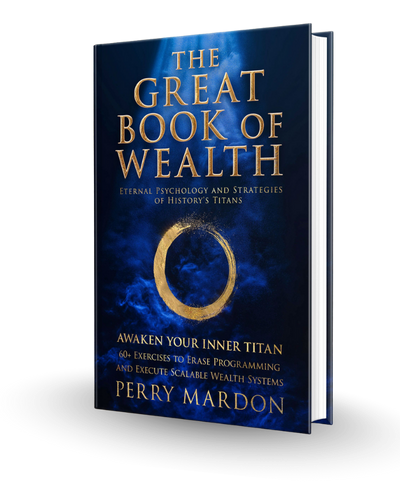
The Great Book of Wealth
Everything in this post traces back to the work in the book. The patterns, the mechanism, the way out. Read it.